
How One Man’s Work Is Redefining Africa’s Cultural Future
Aihawu Victor does not fit neatly into any single category. He is a humanitarian who has shaped migration policy at the Global Forum on Migration and Development and within Nigeria’s federal government. He is the founder of the Cultural Hangout Festival, which has brought African and diaspora culture to the stages of South Kensington, Hyde Park Corner, Crowne Plaza Manchester, and Abuja. And he is now the development consultant guiding Badagry Local Government and Badagry West Local Council Development Area on heritage site preservation, monument remodelling, and the creation of tourism experiences for one of West Africa’s most historically significant coastal communities. We sat with him to understand how all three worlds connect.
PART ONE — MIGRATION, POLICY AND THE HUMAN STORY
Q: Mr. Victor, most people know you as a migration expert. But your work spans so much more than that. Where does the migration story begin for you?
A: The migration story officially began in 2005 when CYID was founded. But long before that, I was already living with it. I grew up in Agbara and I witnessed, right in my neighbourhood, how young girls were being smuggled into Nigeria from neighbouring countries for domestic servitude. They were mostly abused by their employers, maltreated, and invisible to the system. The suppliers of these girls lived in the same area I lived in. At the same time, I was watching young men and young ladies being ferried across land borders — they were trying to reach Europe, and back then pimps called the ladies ‘domitila.’ So I did not come to migration as an academic or a policy person. I came to it as a witness. I grew up with the intention of creating awareness about what I had seen — and CYID was the structure through which I made that intention concrete.
“I did not come to migration as an academic or a policy person. I came to it as a witness.”
Q: You have operated at the highest levels of global migration policy — the Global Forum on Migration and Development, GIZ, PICUM in Brussels, federal government committees in Nigeria. How did a grassroots organisation from Badagry reach those spaces?
A: My simple answer is passion. I am a humanitarian, and I am consistent in what I do. But there was also a strategic decision. At a point in my journey, I felt that my impact in the migration space would be felt more deeply if I could connect the main actors — government, civil society, international organisations, communities. That conviction led me to relocate from Lagos to Abuja, to be closer to where those connections happen. Abuja is where the federal policy conversations take place, and being present in that space — consistently, with credibility built from real community work — is what opened the doors to GFMD and others.
Q: You are a trained trauma therapist. That is unusual for someone with such a prominent policy profile. How does that sit alongside your work?
A: The training came out of necessity. In the course of my work with survivors of trafficking in persons, victims of domestic violence, and returnee migrants, I realised that mere psychosocial counselling was not sufficient. The people I was working with carry very heavy baggage — shame, displacement, trauma, loss of identity. Standard approaches were not reaching them at the depth they needed. It was at that point that my mentor, a German, introduced me to the FastReset trauma healing training programme. I attended the training in Munich, Germany. The developer and owner of the course is Italian — it is a specialised, deep methodology. That training changed how I approach every conversation, every programme, every intervention. It is the foundation of Take Charge! Own and Rebuild Your Life. And it is why I believe that before a person can rebuild life externally, there must first be healing, clarity, confidence, and personal direction internally.
PART TWO — THE CULTURAL HANGOUT FESTIVAL AND THE MEANING OF HERITAGE
Q: Let us talk about the Cultural Hangout Festival. You have taken CHF to South Kensington London, Hyde Park Corner London, Crowne Plaza Manchester, and Abuja. How did a migration expert end up running a cultural festival?
A: The answer is simple — migration and culture go hand in hand. No one travels and leaves their culture behind. Culture is an integral part of the migration experience. The migrant carries their culture with them, and the host community also has its own culture. When those two worlds do not understand each other, you get conflict, marginalisation, and identity confusion. People who lack connection with their own culture have an identity problem — they are neither here nor there. The Cultural Hangout Festival was established to bridge that gap: to promote culture, to create awareness about the importance of every community appreciating and owning their cultural identity. It was also through the CHF experience that I created an awareness training programme for midwives titled Culture Means No Harm — because cultural misunderstanding in healthcare settings can cost lives, and midwives are at a critical intersection of culture and care.
“No one travels and leaves their culture behind. Culture is an integral part of the migration experience.”
Q: You organised CHF on International Migrants Day at Hyde Park Corner in December 2025. That is a very deliberate combination — culture and migration in one event. Was that intentional?
A: Completely intentional. Migrants contribute enormously — to their host countries and to their own countries of origin. Yet International Migrants Day is often observed with statistics and policy statements. We decided to observe it differently — by celebrating migrant achievement in the United Kingdom through the Cultural Hangout Festival. The event was implemented in partnership with Migrant Voice, one of the UK’s leading migrant advocacy organisations. It was a statement: that migration is not just a problem to be managed. It is a human story to be celebrated.
Q: The Cultural Hangout Festival has African Union endorsement. How significant is that to you?
A: Very significant. The maiden edition was organised in commemoration of Africa Day at South Kensington, London. Africa Day is itself a product of the African Union, and it was with great joy that CHF received the AU’s endorsement. They saw it as a genuine platform for uniting the African diaspora and people of African descent in London — not a commercial event, not a performance for outsiders, but a space of authentic cultural reunion. That recognition from the continent means a great deal.
PART THREE — BADAGRY, COASTAL DU MONDE AND THE FUTURE OF HERITAGE TOURISM
Q: You are now consulting for Badagry Local Government and Badagry West Local Council Development Area through Coastal du Monde. How did that come about?
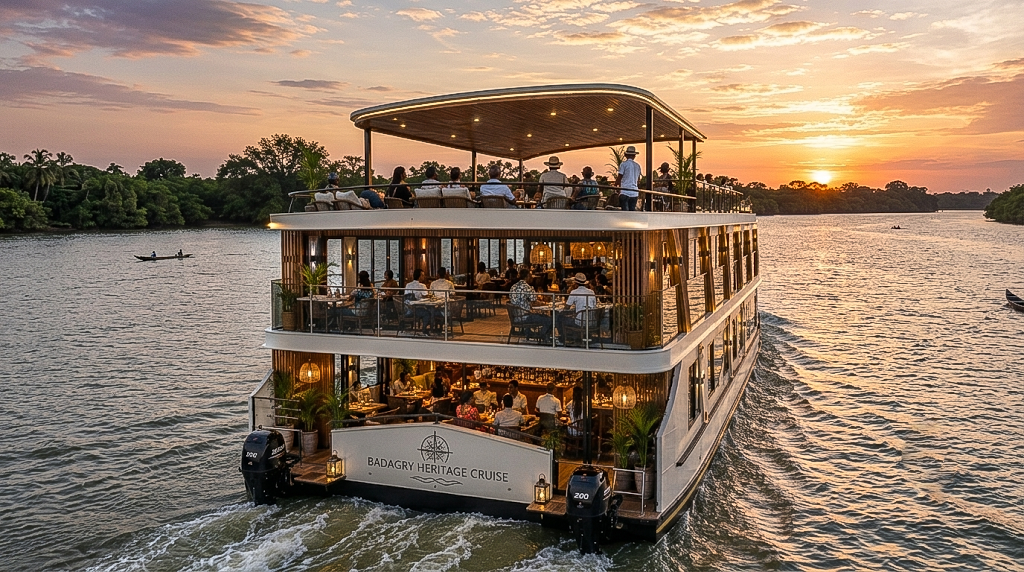
A: Badagry is a tourism destination with monuments but without experiences. That is the problem I identified. My migration journey has taken me to many countries, and I have seen how other communities turn their history into living, breathing visitor experiences that generate economic activity and community pride. I felt I should bring that experience to bear in Badagry — my hometown that I love deeply. I wrote to the councils, presented Coastal du Monde’s proposal and designs to revamp the area’s tourism potential, and they accepted. It is as straightforward as that. When the work is credible and the vision is clear, doors open.
“Badagry is a tourism destination with monuments but without experiences. That is the problem I identified.”
Q: What does creating experiences around tourism monuments actually mean in practice?
A: At its core, it means improved economic activity for residents and increased revenue for the councils. When you create an authentic, immersive heritage experience — when visitors stay longer, spend more, and return — the entire community benefits. Artisans sell their work. Local guides have meaningful employment. Hotels and restaurants receive guests. The monument becomes an anchor for a local economy, not just a historical footnote. That is what we are building in Badagry.
Q: And the Path to Healing International Centre — how does that fit into all of this?
A: Badagry has a huge slave history. Gberefu Island is where an estimated 500,000 enslaved people passed through on their way to the Atlantic — to the Point of No Return. The Path to Healing International Centre, designed by Coastal du Monde, is to provide a space purely for reflection, memorial, forgiveness, and healing for descendants of victims of the slave trade. But it goes further than that. It will be a meeting point — between generations of the victims and generations of the slave masters — for the purpose of healing. That is something the world does not yet have. A permanent, purpose-built institution where that encounter can take place, on the very soil where the history happened.
“It will be a meeting point — between generations of the victims and generations of the slave masters — for the purpose of healing.”
Q: You have described Badagry as having a stronger ancestral claim for the African American and Caribbean diaspora than even Ghana. Is that a bold claim?
A: It is a claim based on secondary data — genetic ancestry research, historical shipping records, and the documented proportion of the transatlantic slave trade that passed through the Bight of Benin. I am not making it as a competitive statement against Ghana, which has done extraordinary work in positioning itself for the diaspora. I am making it as an evidence-based observation that Badagry’s story is deeply connected to a very large proportion of the African diaspora — and that connection has not yet been fully explored or developed.
PART FOUR — THE BIGGER PICTURE
Q: Looking across everything — CYID, CHF, Coastal du Monde, the Path to Healing — is there a single thread that connects it all?
A: My experience across different sectors. Everything I have done has taught me something that fed into the next thing. The migration work taught me about people in displacement and what they carry. The cultural work taught me about identity and healing. The trauma training taught me about the depth of what people need to rebuild. And all of that is now informing the heritage tourism work — because a destination experience, done well, is also a healing experience. These are not separate careers. They are one journey.
Q: What do you want people to take from your work — not the programmes or the projects, but the underlying message?
A: Leave the world better than you found it. That is it. That is everything. If what I have done — CYID, CHF, Coastal du Monde, the Path to Healing — leaves even a small part of the world more dignified, more healed, more culturally connected than it was before I arrived, then the work was worth doing.
“Leave the world better than you found it. That is it. That is everything.”
Q: Finally — what is next for you?
A: The launch of a cultural and heritage souvenir that I have been working on for six years. It has been a long journey of research, design, and development — rooted in cultural heritage and created to give clients something tangible and culturally meaningful. After six years, it is nearly ready. Watch this space.— End of Interview —
Aihawu Victor is the Director of the Centre for Youths Integrated Development (CYID), Platform for Cooperation on Mixed Migration (PCMM).
CEO of Africa Multicultural & Heritage Promotion Ltd (AMHP) Brand owner of Cultural Hangout Festival (CHF) Coastal Du Monde (CDM) Coastal Fashion and Art Show (CFAS) and KIMA. Podcast @rebuildwithvictor on youtube
Great work!